about
how pro live reporting works, where our data comes from, and why you stay in control the whole time.
new to performance royalties? start with our plain-language guide
when your song is performed live at a concert, festival, or event, you're owed performance royalties through your pro (performing rights organization). but bmi and ascap only automatically survey the highest-grossing tours. if you're not on that list, the only way to collect is to manually report each performance yourself.
- —report via ols.bmi.com
- —3-step wizard: event details, venue, setlist
- —biannual filing deadlines (3-6 months per show)
- —requires venue name, address, attendance, dates
- —~5 minutes of data entry per show
- —report via members.ascap.com
- —onstage portal for live performances
- —similar reporting window
- —requires venue, date, songs performed
- —csv upload or manual entry
setlist royalty tracker automates the discovery and data-gathering steps. instead of manually searching for concerts, copying venue details, and typing setlists into bmi or ascap forms — we find the performances, organize the data, and let you submit in seconds via our chrome extension that auto-fills the pro forms, or a csv export.
we never submit anything on your behalf. every performance passes through your review before it reaches bmi live or ascap onstage.
see it in action
set up your artists and songs once, then let us handle the rest.
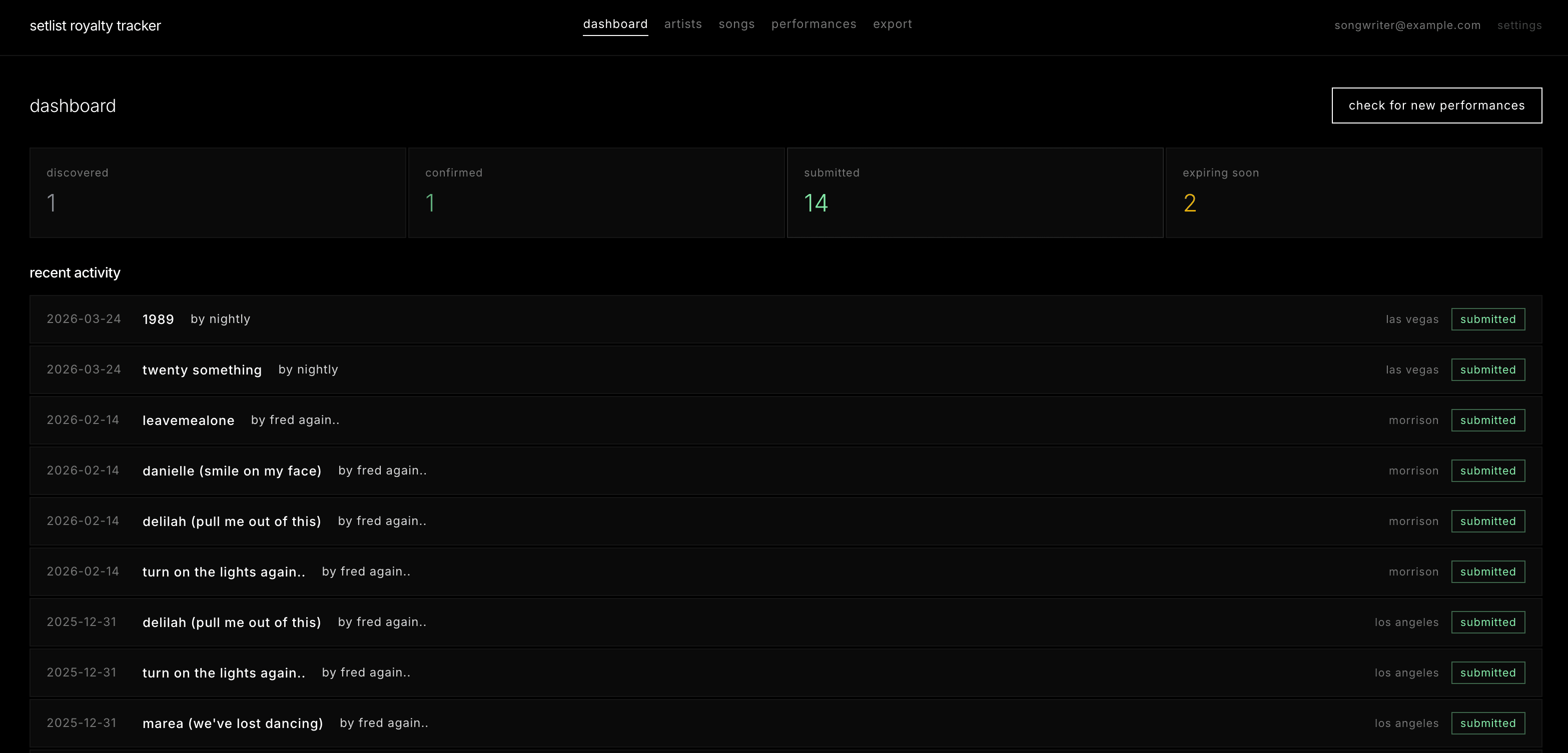
your royalty command center
see everything at a glance — discovered performances, submission status, and expiration warnings. hit scan to check for new concerts anytime.
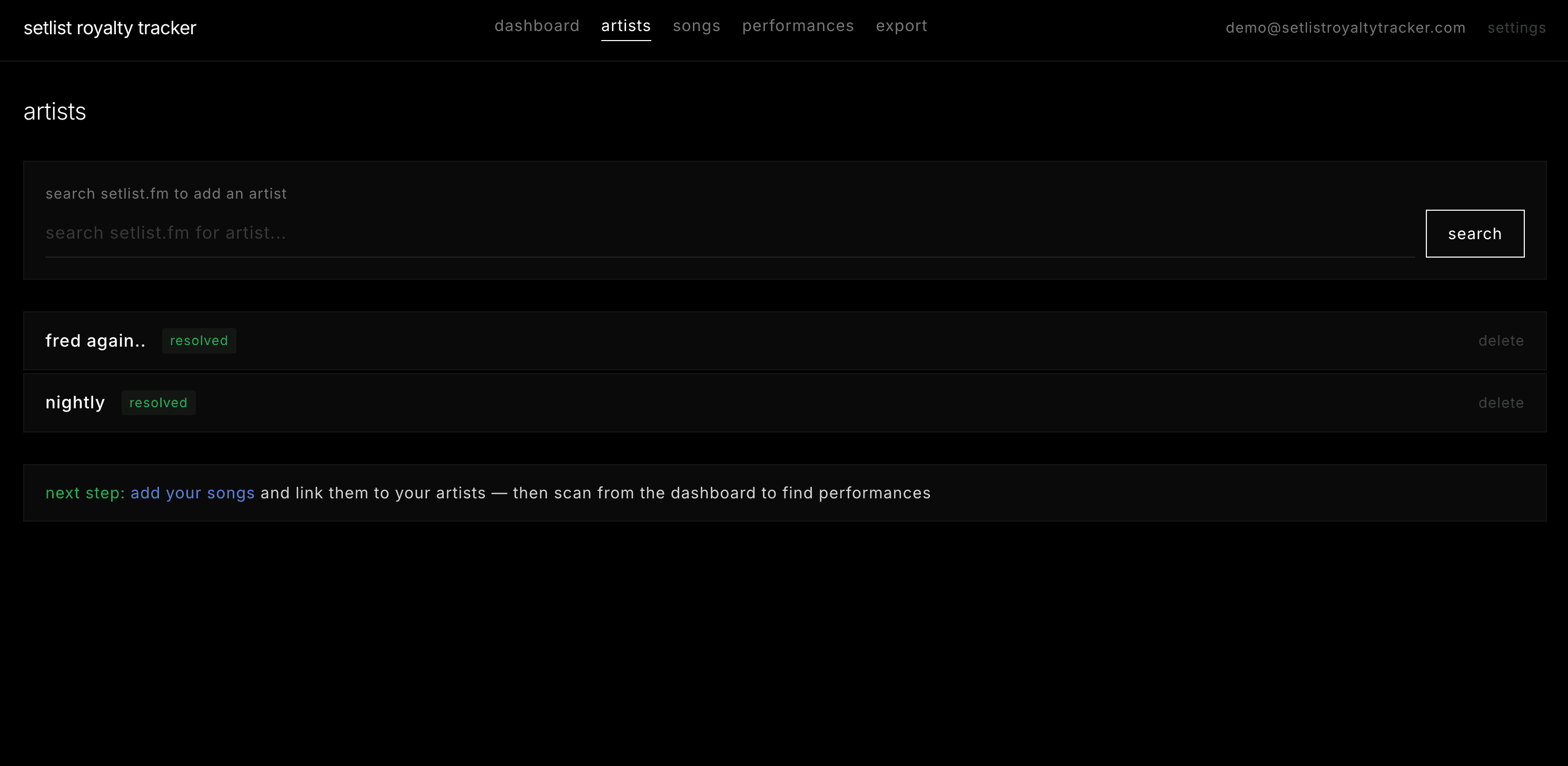
add your artists once
search setlist.fm and add the artists you write for. this is a one-time setup — once added, we'll keep scanning for new performances automatically.
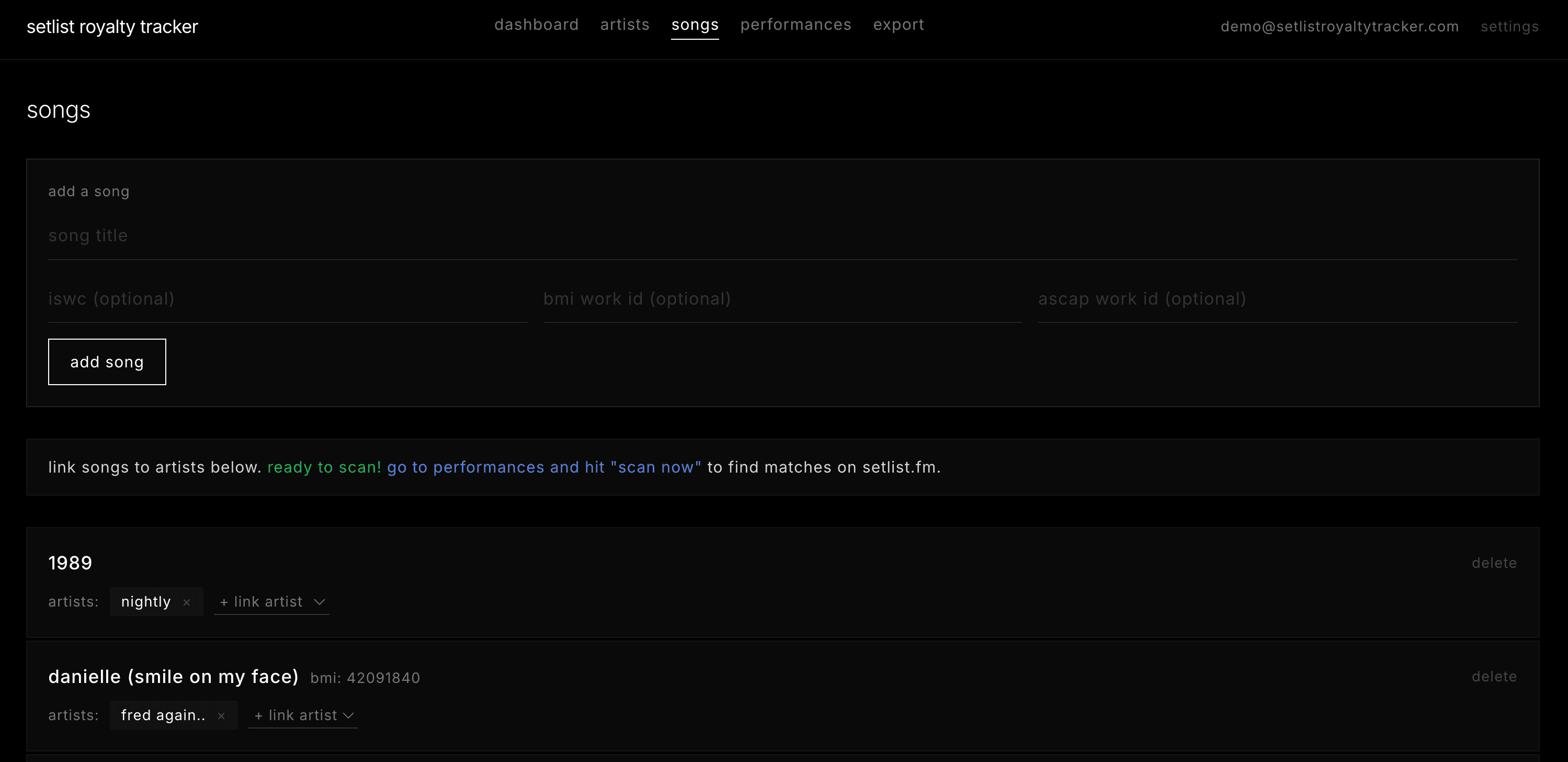
register your songs
add your songs and link them to artists. include your bmi or ascap work id if you have it. like artists, you only do this once — unless you release new music.
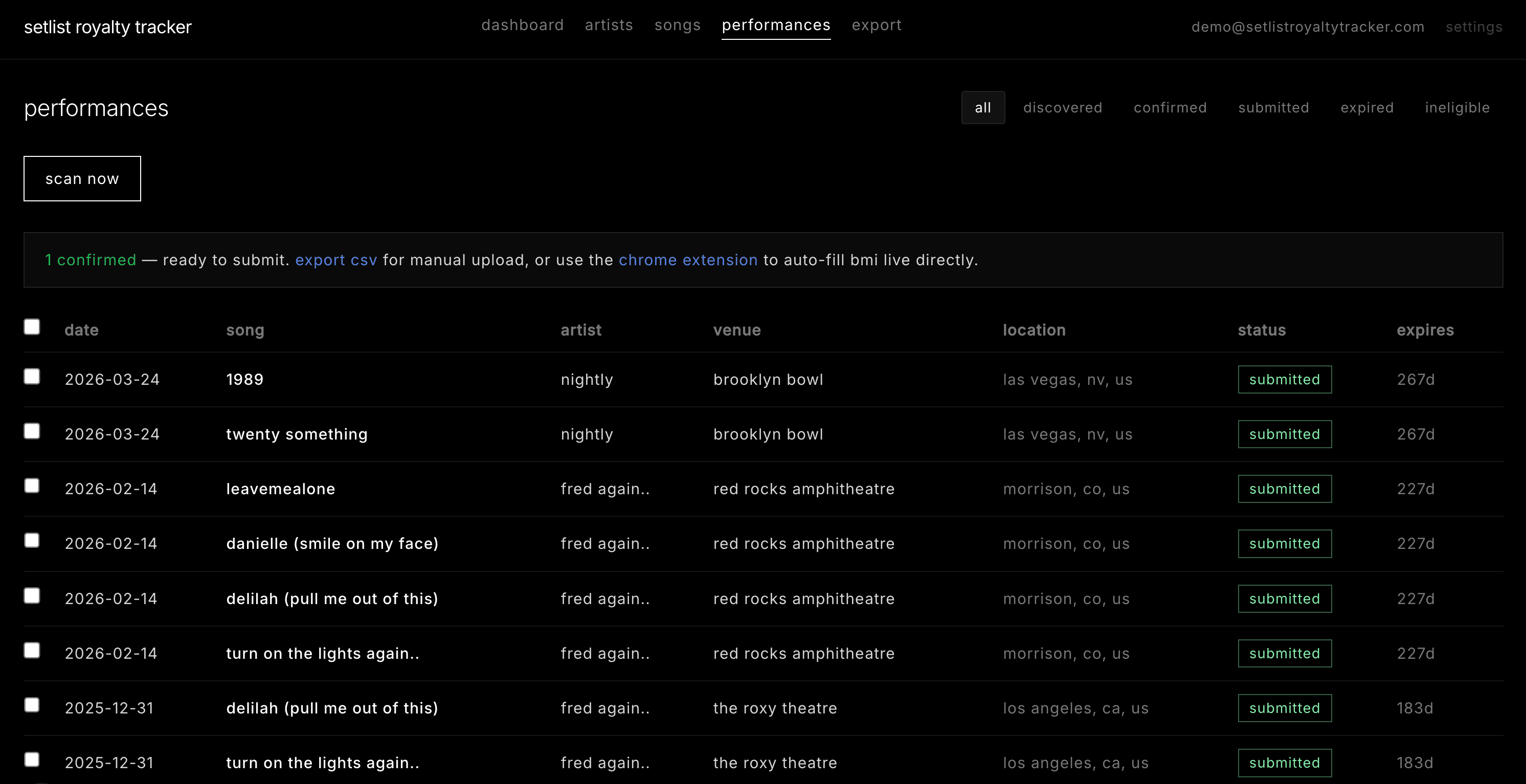
we find your performances
hit scan and we search setlist.fm's 9.6m+ setlists for concerts where your songs were played. review matches, confirm the real ones, and track submission status.
not affiliated with or endorsed by any pro · we automate your existing workflow
data accuracy
setlist royalty tracker helps you discover and organize live performance data — but the data comes from crowdsourced databases maintained by volunteers, not official sources. setlist.fm setlists, musicbrainz metadata, and venue information may contain errors, omissions, or incorrect attributions.
you are responsible for reviewing all matched performances before submitting them to your performing rights organization. we provide tools to make this easier (auto-fill, csv export, missing field warnings), but the final submission is yours — verify dates, venues, song titles, and work ids before filing.
setlist royalty tracker is an independent tool. we are not affiliated with, endorsed by, or partnered with bmi, ascap, sesac, gmr, or any other performing rights organization.
no. setlist royalty tracker is an independent tool that helps you prepare and organize your live performance data. you still submit directly to bmi live or ascap onstage yourself — we just automate the tedious data entry so you don't miss bmi's biannual filing deadline.
we pull setlist data from setlist.fm, a community of 300,000+ contributors who document concert setlists worldwide. setlist.fm has 9.6 million+ setlists cataloged. for dj-producers, serato dj history import is live today — upload your csv and we match tracks against your registered songs. we match all sources against the songs you've registered in your account.
never. you maintain full control. when we discover a matching performance, it enters a "discovered" status. you review and confirm it, fill in any missing venue details, then use the chrome extension to auto-fill bmi live directly (requires google chrome; ascap onstage auto-fill coming soon), or export a csv as a backup. nothing is sent without your explicit action.
we use a layered approach: fuzzy title matching catches the obvious cases, and musicbrainz work-relationship matching catches remixes, edits, and renamed versions of your compositions. so "midnight bass (extended mix)" is recognized as the same composition as "midnight bass." you always review matches before confirming — if something doesn't look right, you can mark it as ineligible.
electronic music has a significant royalty gap (afem estimate) because dj sets at clubs and festivals almost never get reported to pros. our dj-producer support is live today: upload your serato dj history, we match the tracks to your registered songs (including remixes via musicbrainz work relationships), and the chrome extension fills the bmi form (ascap auto-fill coming soon). important: performance royalties go to the songwriter — if you produce original tracks, you earn royalties when other djs play them. if you only dj other artists' music, the royalties belong to those songwriters.
yes — if you wrote the music. they're two completely separate revenue streams. the venue pays the dj a performance fee for showing up. your pro pays the songwriter a performance royalty for the use of their composition. if you wrote the track, you're owed performance royalties whether you played it yourself, another dj played it, or you weren't at the show at all. djs who only play other artists' music do not earn performance royalties — those belong to the original songwriters.
bmi runs biannual filing deadlines, not a flat 9-month window. each performance falls into a 6-month tracking window with a 3-month grace period for filing — so the practical filing window is typically 3-6 months from the event date depending on when in the quarter the show happened. specifically: q1 perfs (jan-mar) → file by jun 30 same year. q2 perfs (apr-jun) → sep 30. q3 perfs (jul-sep) → dec 31. q4 perfs (oct-dec) → mar 31 next year. the app calculates the exact deadline for each performance and warns you as it approaches. miss it and you can't claim royalties for that performance.
yes. if you have compositions registered with bmi or ascap and those songs are performed live by any artist, this tool helps you discover and report those performances — whether you're the performer, songwriter, or publisher.
your account uses passwordless magic link authentication — no passwords stored. your song catalog and performance data are private to your account. the chrome extension authenticates via a unique api key that you generate and can regenerate at any time.
the auto-fill chrome extension works in google chrome and other chromium-based browsers (microsoft edge, brave, arc, opera, vivaldi), and currently auto-fills bmi live only — ascap onstage support is coming soon. if you use safari or firefox, you can still use the web app and submit performances via the csv export.
magic link login · no password required